Sunday, July 30, 2006

PRÉMIO NACIONAL DO AMBIENTE 2006

ATRIBUíDO O
PRÉMIO NACIONALDO AMBIENTE:
CINE ECO
(Festival Internacional
de Cinema e Vídeo do Ambiente
da Serra da Estrela, Seia, Portugal)
Atribuído pela
Confederação Portuguesa das Associações
de Defesa do Ambiente

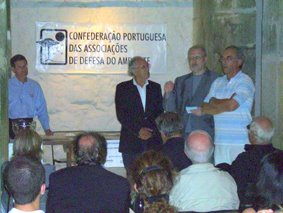
A cerimónia efectuou-se no
Dia Nacional da Conservação da Natureza
(28 de Julho de 2006)
na Museu da Água
(Jardim do Principe Real - Lisboa)


Falando sobre o Festival e a sua importância

Os directores do Cine Eco
(Lauro António e Carlos Teófilo)
"afirmaram ficar muito satisfeitos com o Prémio,
mas não o agradecem.
Se não fosse merecido, não o teríamos ganho.
Se ganhámos, merecemos.
O estímulo obriga-nos a crescer
e acarreta novas responsabilidades.
Ainda bem, para o Festival ser cada vez melhor."
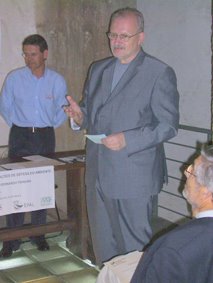
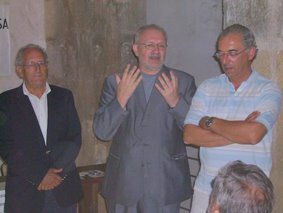
O Dr. João Manuel Caetano, da CPADA,
presidiu á cerimónia, e entregou os galardões.

O Prémio vai para Seia,
"para uma das monstras da sala do Cine Teatro
onde há onze edições decorreu o Festival,
que este ano, tal como sempre,
acontecerá no mês de Outubro.
"PRÉMIO CARREIRA:
PROF. DR. FERNANDO CATARINO


Outro Prémio que o Cine Eco sauda efusivamente:
Prémio Carreira para o Prof. Doutor Fernando Catarino,
aqui numa das sua apreciadas "lições".
O Prof Fernando Catarina
vai voltar a Seia em Outubro,
como Presidente do Júri Internacional
do Cine Eco.

Tuesday, July 25, 2006

CINE ECO 2006

ALGUMAS OBRAS A CONCURSO JÁ SELECCIONADAS
(em fim de Julho de 2006)


O PROFETA DAS ÁGUAS, DE LEOPOLDO NUNES (BRASIL, 2006); DOCUMENTÁRIO; 85’


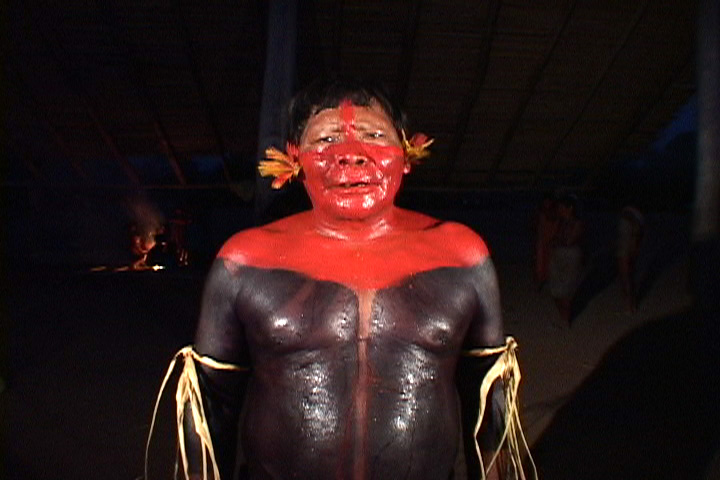
O AMENDOIM DA CUTIA (KIARÃSÂ YÕ SÂTY, O AMENDOIM DA CUTIA), DE KOMOI E PATURI PANARA (BRASIL, 2006); DOCUMENTÁRIO; 51’


PEIXE FRITO, DE RICARDO GEORGE DE PODESTÁ (BRASIL, 2005); ANIMAÇÃO; 19’


É DA RAIZ, DE ANGELO LIMA (BRASIL, 2006); DOCUMENTÁRIO; 12’

MUITCHAREIA, DE ULIANA DUARTE (BRASIL, 2006); DOCUMENTÁRIO; 69’

OURO BRANCOO VERDADEIRO PREÇO DO ALGODÃO (WHITE GOLD - THE TRUE COST OF COTTON), DE SAM COLE (INGLATERRA, 2005); DOCUMENTÁRIO; 8’

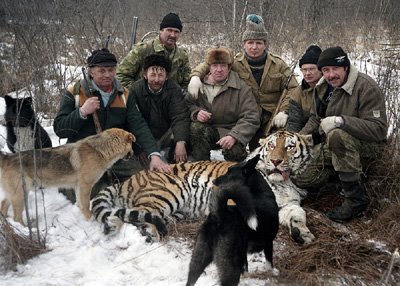
CONFLITO TIGRE (CONFLICT TIGER), DE SASHA SNOW (RÚSSIA, 2005); DOCUMENTÁRIO; 61’


OVAS DE OURO (OVAS DE ORO), DE MANUEL GONZALES (CHILE, 2005); DOCUMENTÁRIO; 63’


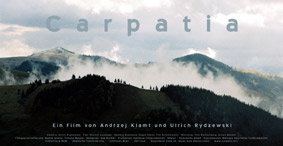
CARPATIA, DE ANDRZEJ KLANT E ULRICH RYDZEWSKY (ÁUSTRIA, 2004); DOCUMENTÁRIO; 127’

Thursday, July 20, 2006

A Confederação Portuguesa
de Associações de Defesa
do Ambiente
(*)
acaba de atribuir o
PRÉMIO NACIONAL
DE AMBIENTE
(FERNANDO PEREIRA)
2006
ao
CINEECO
Festival Internacional
de Cinema e Vídeo
do Ambiente da Serra da Estrela


Parabéns a todos o que me têm ajudado a transformar este festival no único festival português de ambiente, com doze anos de idade, e prestígio crescente, quer a nível nacional quer a nível internacional.Parabéns também a todos os que nele acreditaram, e nele colaboraram como criadores de obras a concurso, como jurados, como convidados, como amigos.Parabéns também aos que nunca acreditaram, aos que invejaram e maltrataram, aos “velhos do Restelo” que os há em todas as praias, mesmo onde não há praias, e ainda aos que mesquinhamente tentaram/tentam/tentarão destruir uma obra erguida com abnegação e muito amor: sem o seu incentivo, tudo teria sido mais difícil.Parabéns aos companheiros de sempre, os presentes, os futuros e a alguns que ficaram pelo caminho. Não os esqueceremos. Obrigado pelas próximas edições, que serão cada vez melhores, e mais inspiradoras.À Confederação Portuguesa de Associações de Defesa do Ambiente não agradeço. Julgo que se não merecêssemos, não teríamos ganho. Se ganhámos com merecimento, não agradecemos. Apenas dizemos que o estímulo nos faz crescer, nos responsabiliza mais.Um Prémio Nacional do Ambiente é algo que só acarreta responsabilidades.(*) A CPADA (Confederação Portuguesa de Associações de Defesa do Ambiente) é a maior organização ambientalista do nosso País, integrando 110 ADA/ONGA (Associações de Defesa do Ambiente/Organizações Não Governamentais de Ambiente) de âmbitos Nacional, Regional e Local, de grande diversidade temática (conservação da natureza, ordenamento do território, património construído, ambiente urbano, transportes alternativos, bem estar animal, agricultura biológica, educação ambiental e actividades específicas, como espeleologia, montanhismo, escutismo e cicloturismo), espalhadas no Continente e Regiões Autónomas, que representam, no seu todo, muitas dezenas de milhar de associados.O Prémio será entregue no dia 28 de Julho de 2006, Dia Nacional da Conservação da Natureza, no Museu da Água, em Lisboa.
Entretanto, a próxima edição está na calha:Cinema e AmbienteEnvironmental Film and Video / entrega de inscrições até 30 de Agosto.

Monday, May 22, 2006

BOLETINS DE INSCRIÇÃO

Se quer receber o boletim de inscrição do Cine'Eco 2006 escreva para:
filmfestival@portugalmail.pt

If you want to receive the Cine'Eco Registartion Form, write us at:
filmfestival@portugalmail.pt

REGULAMENTO 2006


CINEECO ’2006
XII Festival Internacional de Cinema e Vídeo de Ambiente
da Serra da Estrela, Seia, Portugal

20 a 29 de Outubro de 2006

REGULAMENTO GERAL

1. DA ADMISSÃO

1.1. A secção competitiva do CineEco’2006 – XII Festival Internacional de Cinema e Vídeo de Ambiente da Serra da Estrela, que decorrerá em Seia, entre 20 a 29 de Outubro de 2006, é aberta a todos os concorrentes nacionais e estrangeiros, profissionais ou não profissionais.

1.2. O presente Festival tem como objectivo primeiro a promoção dos valores naturais, ecológicos e culturais e ainda a promoção ambiental e turística da Serra da Estrela. A temática do Festival será essencialmente o ambiente, na sua concepção mais “lata”, abarcando todo o meio envolvente.

Uma atenção muito especial será reservada ao audiovisual (cinema e vídeo) da Lusofonia, produzido por Países de Expressão Portuguesa, através da instituição de um Prémio Especial que consagre essa valência.

1.3. Todas as obras inscritas devem ter sido realizadas depois de 1 de Janeiro de 2004.

2. DA INSCRIÇÃO

2.1. A inscrição das obras a concurso deverá ser efectuada, através de boletim anexo (pode ser fotocopiado), até 31 de Agosto de 2006. Os boletins de inscrição devem ser correctamente preenchidos e de forma completa, em letra de imprensa, de modo a facilitar a elaboração do catálogo, acompanhados de uma cópia em VHS/PAL de cada obra a concurso.

2.2. A entrega das cópias deverá realizar-se até 15 de Setembro de 2006.

2.3. Cada concorrente pode apresentar o número de obras que quiser, desde que inéditas neste certame, inscrevendo cada uma delas num boletim diferente. Agradece-se a inclusão de fotografias das obras concorrentes e dos seus realizadores, dados biofilmográficos, além de outros elementos informativos.

2.4. O XII Festival Internacional de Cinema e Vídeo de Ambiente da Serra da Estrela entende por profissional e não profissional as obras que sejam ou não pagas e/ou encomendadas por entidades exteriores ao autor. As obras das Escolas de Cinema e Vídeo, nacionais ou estrangeiras, deverão referir expressamente essa proveniência e serão nesse caso entendidas como obras não profissionais.

2.5. Cada concorrente deverá enviar boletins e cópias para:
Secretariado do CineEco ‘2006
XII Festival Internacional de Cinema e Vídeo de Ambiente
da Serra da Estrela
Av. EUA, nº 100 – 6º Dt. 1700 – LISBOA – PORTUGAL
Telef e fax: 351.217962799
Email: cineeco@netcabo.pt

2.6. As obras de países estrangeiros poderão ser enviadas para as respectivas representações diplomáticas em Lisboa, desde que seja dado conhecimento desse facto à organização do Festival.

3. DAS CÓPIAS

3.1. São admitidas cópias das obras nos seguintes suportes:

1. Película - 35 ou 16 milímetros
2. Vídeo - Betacam / VHS/PAL
3. DVD – Zona 2

3.2. As obras de vídeo na categoria não profissional não deverão ultrapassar os 20 minutos. Em relação às obras de vídeo profissional, estas não deverão ir além dos 60 minutos.
Na modalidade de cinema/ficção não haverá limite de tempo.
Poderão ser consideradas excepções a estas restrições, sempre que o Júri de Pré-Selecção o ache justificado pela qualidade e interesse das obras em questão, ou desde que as mesmas tenham sido convidadas a participar no Festival. Para as obras candidatas ao Prémio Especial da Lusofonia não haverá qualquer limitação de tempo.

3.3. As obras deverão ser faladas ou legendadas em português, espanhol, francês ou inglês.

3.4. As obras concorrentes ao Prémio Especial da Lusofonia terão obrigatoriamente de ser faladas em português, podendo ou não comportar outras línguas ou dialectos.

4. DOS PRÉMIOS
4.1. Serão atribuídos os seguintes Prémios, sem recurso a ex-aequo:

I. Grandes Prémios:
* Grande Prémio Ambiente (Câmara Municipal de Seia), no valor de €3.750 (três mil setecentos e cinquenta euros), atribuído à obra que seja considerada a melhor entre todas as presentes a concurso, em qualquer categoria de temática ambiental.
* Prémio Especial de Lusofonia, no valor de €2.500 (dois mil e quinhentos euros), atribuído à obra, produzida e realizada em país lusófono, que seja considerada a melhor entre todas as presentes a concurso.
II. Primeiros Prémios nas seguintes categorias:
- Prémio “Educação Ambiental”, no valor de €1.250 (mil duzentos e cinquenta euros), relativo à obra que melhor aborde, do ponto de vista didático-pedagógico, os temas a concurso.
- Prémio “Água”, no valor de €1.250 (mil duzentos e cinquenta euros), à obra a concurso que melhor promova o tema dos recursos hídricos.
- Prémio “Valorização de Resíduos”, no valor de €1.250 (mil duzentos e cinquenta euros), à obra a concurso que melhor promova o tema dos resíduos.
- Prémio “Vida Natural”, no valor de €1.250 (mil duzentos e cinquenta euros), à obra a concurso que melhor promova o tema da conservação da Natureza e da bio-diversidade.
- Prémio “Pólis”, no valor de €1.250 (mil duzentos e cinquenta euros), à obra a concurso que melhor promova o tema da requalificação urbana e valorização ambiental.
- Prémio “Antropologia Ambiental”, no valor de €1.250 (mil duzentos e cinquenta euros), à obra a concurso que melhor promova o tema da inserção do homem no seu quotidiano.
- Prémio “Vídeo Não Profissional”, no valor de €1.250 (mil duzentos e cinquenta euros), à melhor obra não profissional inscrita a concurso.

4.2. Caso o Júri assim o entenda, poderão ser atribuídas Menções Honrosas.

4.3. Os Prémios atribuídos serão acompanhados por um troféu “Campânula” e um diploma.

5. DO JÚRI

5.1. As obras concorrentes serão apreciadas inicialmente por um Júri de pré selecção, que incorporará dois elementos a indicar pelas entidades organizadoras e um elemento de reconhecida idoneidade ligado ao campo audiovisual, escolhido pela Direcção do Festival.

5.2. As obras concorrentes seleccionadas pelo Júri de Pré-Selecção serão depois apreciadas e classificadas por um Júri Internacional, especialmente convidado para o efeito e que será constituído no mínimo por cinco personalidades de reconhecido mérito e idoneidade intelectual e cultural, com particular incidência no campo do cinema e do audiovisual, e das áreas científicas abordadas.

5.3. As obras passíveis de serem galardoadas com o Prémio Especial da Lusofonia serão igualmente apreciadas e classificadas por um Júri especialmente convidado para o efeito e que será constituído por três personalidades de reconhecido mérito e idoneidade intelectual e cultural.

5.4. Serão os elementos dos Júris a escolher entre si aquele que, enquanto Presidente de cada um dos Júris, será o seu porta-voz.

5.5. Os Júris serão secretariados por um representante do Festival Internacional de Cinema.

5.6. Dentro da maior liberdade e isenção, os Júris poderão atribuir ou não os Prémios previstos neste regulamento, o mesmo se passando quanto à atribuição de possíveis Menções Honrosas.

5.7. Nenhum elemento da Organização e/ou dos Júris oficiais poderá estar ligado à realização das obras admitidas a concurso.

5.8. Das deliberações dos Júris não haverá recurso.

6. DAS DISPOSIÇÕES FINAIS

6.1. Cada concorrente assume a plena responsabilidade pelas obras que tiver inscrito a concurso para todos os efeitos legais, excluindo-se toda e qualquer responsabilidade do XII Festival Internacional de Cinema e Vídeo de Ambiente da Serra da Estrela para com terceiros.

6.2. As despesas de envio das obras, bem como o respectivo seguro serão da responsabilidade do remetente, assegurando a organização as despesas de devolução, bem como o seguro de transporte, salvo quando os autores manifestarem disponibilidade para levantarem as referidas obras junto da organização.

6.3. O Festival não se responsabiliza pela deterioração das cópias devido ao seu uso normal. Em caso de extravio ou destruição anormal, a responsabilidade da Organização limita-se ao valor consignado pelo participante na ficha de inscrição ou de uma cópia tirada em laboratórios portugueses. Em todo o caso, a organização do Festival compromete-se a segurar as obras apresentadas no certame durante o período em que este decorre.

6.4. Todas as obras admitidas a concurso, após passagem pelo Júri de Pré-Selecção, serão visionadas pelos Júris oficiais em sessões públicas, durante o decorrer do certame.

6.5. O XII Festival Internacional de Cinema e Vídeo de Ambiente da Serra da Estrela reserva-se o direito de exibir na TV, no cinema ou noutros meios, pequenos excertos das obras premiadas, ou outras solicitadas pelos meios de comunicação social para esse efeito.

6.6. A organização do Festival agradece aos produtores dos filmes e vídeos premiados que depositem uma cópia em vídeo nos arquivos do Festival, cuja utilização se fará de acordo com o contrato de depósito de Cinematecas estabelecido internacionalmente. Sempre que não for solicitada a devolução das cópias em vídeo, estas ficarão pertença do arquivo do CineEco.

6.7. Os concorrentes deverão respeitar o presente Regulamento, aceitando todas as suas cláusulas, conforme fica demonstrado pela assinatura aposta no Boletim de Inscrição.

6.8. Das decisões da organização, quanto à interpretação e cumprimento deste Regulamento, não haverá recurso.

6.9. Os resultados do concurso serão dados a conhecer na cerimónia de encerramento do XII Festival Internacional de Cinema e Vídeo de Ambiente da Serra da Estrela.

CineEco2006
XII Festival Internacional de Cinema e Vídeo de Ambiente da Serra da Estrela Seia, Portugal
12th International Environmental Film and Video Festival Seia, Portugal
20 a 29 de Outubro/20th to 29th of October

CINE'ECO 2006 RULES


CINEECO ‘2006
12th International Environmental Film and Video Festival
of Serra da Estrela – Seia, PORTUGAL
from 20th to 29 th October 2006

RULES


1. Admission

1.1. The 12th International Environmental Film and Video Festival of Serra da Estrela, which will be held in the city of Seia, from 20th/29th October 2006, is opened to all professional or non-professional, national and foreign candidates.

1.2. The aim of the CineEco’2006 is to promote the Natural, Ecological and Cultural values, as well as the promotion of Serra da Estrela heritage and touristic richness. The main subject of this Festival is the Environment.

A very special attention will be addressed to the video and films produced by Portuguese Speaking Countries. The producers and directors from those countries may register their films and videos to compete in film or video, short or feature length film, fiction or documentary film, to the LUSOPHONE SPECIAL PRIZE.

1.3. All the works presented to the contest should have been made after January 1st, 2005.

1.4. The works presented to this competition should be in accordance with:

A. Film / 35mm
B. Film / 16mm
C. Professional/Video
D. Non/professional/Video

2. Registration

2.1. The works should be presented to the competition through the registration form hereby (Xerox if necessary), which should be sent until 31st of August 2006. The forms should be correctly and completely filled-up, in capital letters.

2.2. The copies should be sent until 15th of September 2006.

2.3. Each participant or candidate can enter as many works as he desires, since they are inedited to this competition.
Every work should be presented in a different registration form.
All registration forms should be accompanied by photos of the works and photos and biographies of the authors/directors, besides other information like bio-filmography.

2.4. According to the 12th International Environmental Film and Video Festival of Serra da Estrela opinion, it is professional or non-professional the video or film that is or is not paid and/or ordered by an outward entity respecting to the author/director. The school’s video or films, national or foreign, should clearly mention its origin and, in that case, they will be understood as non-professional works.

2.5. Each candidate should sent the registration forms and copies to the Festival Office.

Secretariat of the CineEco ‘2006
XII Festival Internacional de Cinema e
Vídeo de Ambiente da Serra da Estrela
Av. EUA, nº 100 – 6º Dt. 1700 – LISBOA – PORTUGAL
Phone e fax: 351.217962799
Email: cineeco@netcabo.pt

3. Copies

3.1. Copies will be admitted, as follows:

1. Film/ 35mm
2. Film/ 16mm
3. Videogram / VHS System /PAL
4. Videogram / Betacam SP System / PAL
5. DVD – Zone 2

3.2. The works in competition in Environment should not exceed 20 minutes, for non-professional video, or 60 minutes, for professional/video. Exceptions to these limitations may be considered whenever the pre-selection Jury decides it, in recognition of their quality and interest, or because they are invited to participate in the contest. For the works competing to the LUSOPHONE SPECIAL PRIZE there will be no limit length. There will be no limit length for fiction/film
3.3. The works should be spoken or sub-titled in Portuguese, Spanish, French or English.

3.4. The works competing for the Lusophone Special Prize should be spoken in Portuguese and they may contain other languages or dialects.

4. Awards

4.1. The Jury will attribute the following awards, without appeal to “ex-aequo”.

I. Greats Prizes:
* Environmental Great Prize (Câmara Municipal de Seia Prize), under the value of €3.750, given to the best among all the works presented to all categories of the competition concerning Environment.
* Lusophone Special Prize, under the value of €2.500, given to the best work produced and directed in a Portuguese speaking Country.
II. Prizes for each one of the following categories:
· Prize “Environmental Education”, under the value of €1.250, given to the best work concerning the general subject of the competition, under an educational point of view.
· Prize “Water”, under the value of €1.250, given to the best work concerning the subject of hydric resources.
· Prize “The Value of Residues”, under the value of €1.250, given to the best work concerning the subject of the utility of residues.
· Prize “Natural Life”, under the value of €1.250, given to the best work promoting the subject of Nature’s preservation and biodiversity.
· Prize “Pólis”, under the value of €1.250, given to the best work promoting the subject of urban qualifying and environmental value.
· Prize “Environmental Anthropology”, under the value of €1.250, given to the best work promoting the subject of human insertion in its daily way of life.
· Prize “Non-professional Video”, under the value of €1.250, given to the best non-professional work presented to the competition.

4.2. If the Jury decides so, honourable awards will also be attributed.

4.3. The winners will receive a diploma and a trophy - “Campânula”.

5. Jury

5.1. The works in competition will be submitted to a pre-selection jury formed by two personalities chosen by the Organization Committee and a personality of recognized competence related to the audio-visual, also chosen by the Festival Directors.

5.2. The work in competition, either in Environment section or Free Discretion section, selected by the pre selection Jury will be submitted to a Special International Jury invited for the occasion and that will be composed by at least 5 personalities of intellectual and cultural competence and recognized aptitude in the cinema, audio visual field as well as critical and ecological capacity.

5.3. The works candidates to the LUSOPHONE SPECIAL PRIZE will also be submitted to a Special International Jury invited for the occasion and that will be composed by a minimum of 3 personalities with intellectual and cultural competence and recognized merit, particularly on cinema and audio visual field, as well as critical activity.

5.4. The Juries’ members will select their chairman among themselves, as well as their spokesman.

5.5. The Juries will also include a member representative of the 12th International Environmental Film and Video Festival of Serra da Estrela with no vote right.

5.6. The Juries have the privilege to choose whether to attribute or not the different awards foreseen in these Rules, as well as the Honourable Mentions.

5.7. No member of the Juries can be connected to the works submitted to this contest.

5.8. From the deliberations or decisions of the Juries there will be no appeal.

6. Final Terms

6.1. For any legal effects, each candidate is responsible for the works he presents, excluding any responsibility at all of the 12th International Environmental Film and Video Festival of Serra da Estrela.

6.2. Expenses of sending the films and videograms as well as appropriated insurances will be under the responsibility of the sender, however the organization will assume the expenses of returning the film and insurance transportation, unless the authors decide to pick-up the films themselves.

6.3. The Festival does not assume the responsibility for the deterioration of the audiovisual copies due to its normal use. In case of loss or abnormal destruction, the responsibility of the Organization Committee will compromise to the value given by the candidate in the registration form or a copy produced in a Portuguese lab. However the Organization Committee compromise to insure the works while presented in contest.

6.4. All the works, after being selected by the pre-selection jury, will be screened in public sessions, during the contest, in the presence of the official juries.

6.5. The 12th International Environmental Film and Video Festival of Serra da Estrela reserves the right to show on TV, Cinema or other medias excerpts of the works awarded or other works requested by other media for divulgation.

6.6. The Festival Organization thanks the producers of films and videos rewarded to deposit a copy in video at the archives of the Festival, which utilization will be made in accordance with the contract of deposit of “Cinematec” internationally established.

6.7. The candidates should respect these general Rules, with the acceptance of all items, as shown by the signature in the Registration Form.

6.8. From the decisions of the Organization regarding the interpretation and decisions of these Rules, there will be no appeal.

6.9. The results of this contest will be known during the Closing Ceremony of the 12th International Environmental Film and Video Festival of Serra da Estrela.

Wednesday, April 12, 2006

CINEECO 2006
SEIA
SERRA DA ESTRELA
Nobody knows Portugal until they have visited the Serra da Estrela Natural Park. Here there is a perfect and rare alliance between open air and people

Situated in the largest mountain range in the country, the Serra da Estrela Natural Park is the source of the rivers Mondego, Zêzere and Alva. More than half of its area is located above an altitude of 700m and it is here, at 1993m, that you will find the highest peak in continental Portugal.

During the Quaternary period, all the region was subjected to the action of ice and once this disappeared visible marks were left on the landscape. Valleys in the shape of horseshoes, ravines, polished rocks and lakes of glacial origin are just some of the formations that demonstrate the importance of the ice and snow in modelling the mountains.

The central plateau, dominated by the Torre and Cântaros, location of the glacial valley of the Zêzere, contrasts with another mountain, the Videmonte plateau, which is still in the initial bed of the Mondego, dotted with isolated farms among fields of rye and pastures where cattle are bred. In the valleys to the south west, decorated by terraces and surrounded by the Penha dos Abutres, are the villages of Loriga and Alvoco, which have developed on powerful rocky spurs. Finally, the north west slope stretches from below Seia to the land dominated by the castle of Linhares and the fields where maize is cultivated and vines are planted up the slopes to where the broom grows. In terms of fauna, the admirable presence of the bear is a thing of the past and even wolves only roam here sporadically. In addition to the wall lizard that is a feature of the region, other species include otters, genets, badgers, wild cats, water moles, red breasted bullfinches, Algerian wall lizards and midwife frogs.

The natural vegetation appears in three separate sectors. Under 900m, in very clearly defined areas. Between 800/900m and 1600m is the domain of the black oak. From 1600m upwards, we find the juniper and the high pastures where the gentian, a plant in danger of extinction, can be found.

The villages in the Serra da Estrela Natural Park area are mainly at the bottom of the mountains and date back to medieval times. However, before this other cultures left their mark on this area. One of the most notable examples of the Roman presence are the remains, still to be seen at Famalicão and Folgosinho, of the road that connected Mérida to Braga. The route by which it crosses the mountain would certainly have caused difficulties in construction. The Arab influence is seen in the irrigation system and the fruit orchards while the Visigothic culture organized all rural space by applying the ‘Visigoth Code’,

Throughout the Natural Park, a traditional mountain economy is practised, centred on agriculture, shepherding of sheep and goats, particularly domestic sheep and the manufacture of Serra da Estrela cheese. The craftsmanship of the region is expressed in basket work using chestnut and wicker, weaving, embroidered cotton and smoked produce.

In an almost imperceptible manner, the alliance between natural and cultural factors is revealed and this makes it possible to discover that any landscape on Estrela proudly shows off its human component. This is the greatest challenge to the visitor to the Serra da Estrela.